“Literature is news that stays news” Ezra Pound
These are some longer performance pieces in my repertoire.
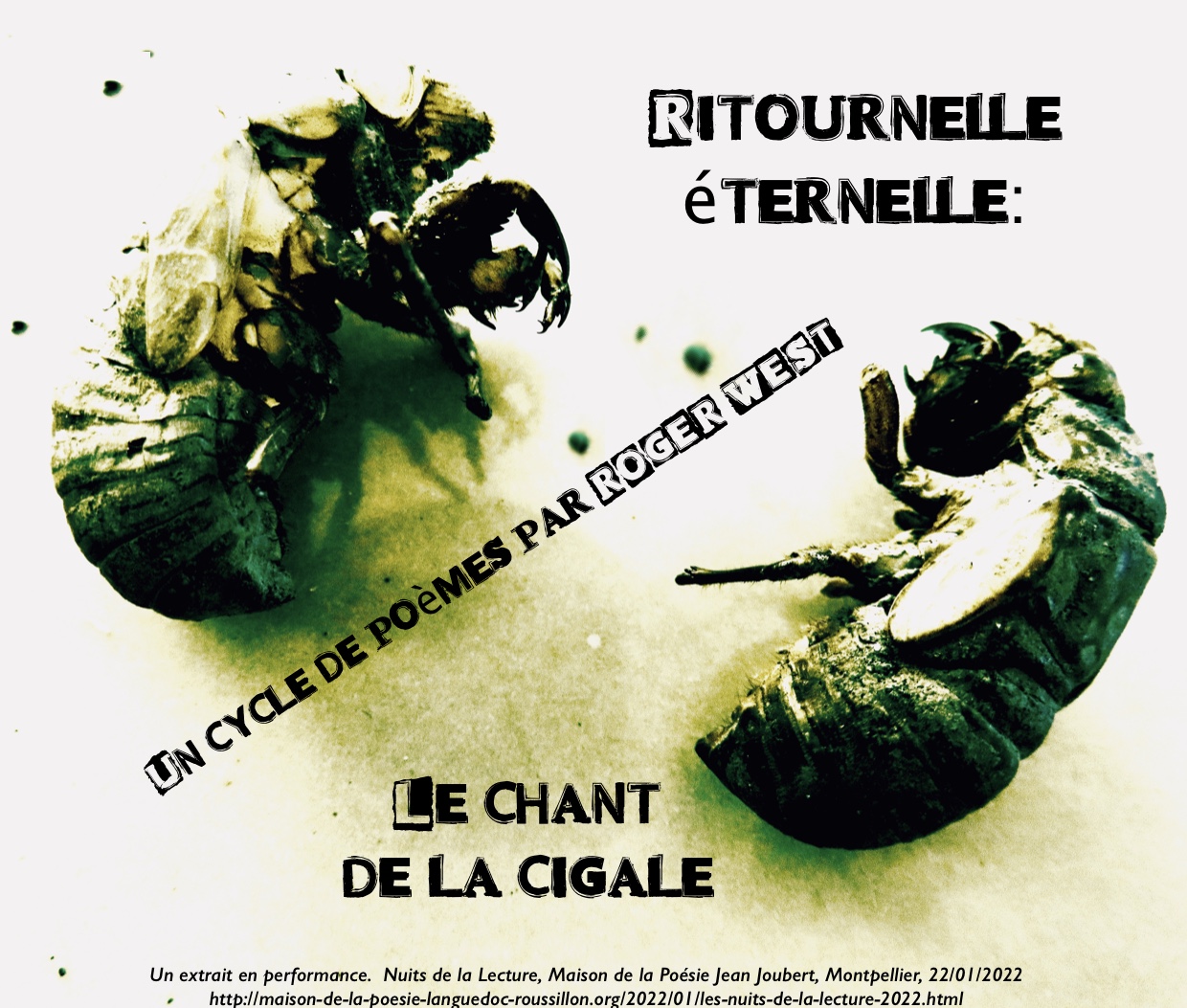
Consider the Song of the Cicada.
A suite of poems that trace the summer months week by week from the first notes of the cicadas to their disappearance in autumn. Each piece is in a different form – formal verse, free verse, prose poem, dialogue, film script, song, sound poem. The suite draws upon ancient Greek mythology and literature, modern political movements, the concept of terroir in the Occitan landscape. The performance lasts around 50 minutes. It is accompanied by electronic soundscapes and a live musician. There is an English and a French version. It has been performed at the Great Falls Spoken Word Festival in Massachusetts with Tony Vacca on kora and percussion, at Poetry in Aldeburgh with Seb Frey on percussion, at Printemps des Poètes in Lodève, France, with Delphine Chomel on violin, at the Austin International Poetry Festival with Francis McGrath on keyboards, at the Tunbridge Wells Poetry Festival with Paul Gunn on piano, at the Suffolk Poetry Festival with Kate Rex as puppeteer and at Mots du Vent in Fontjoncouse, France, with Bob Morse on guitar, percussion and trumpet.
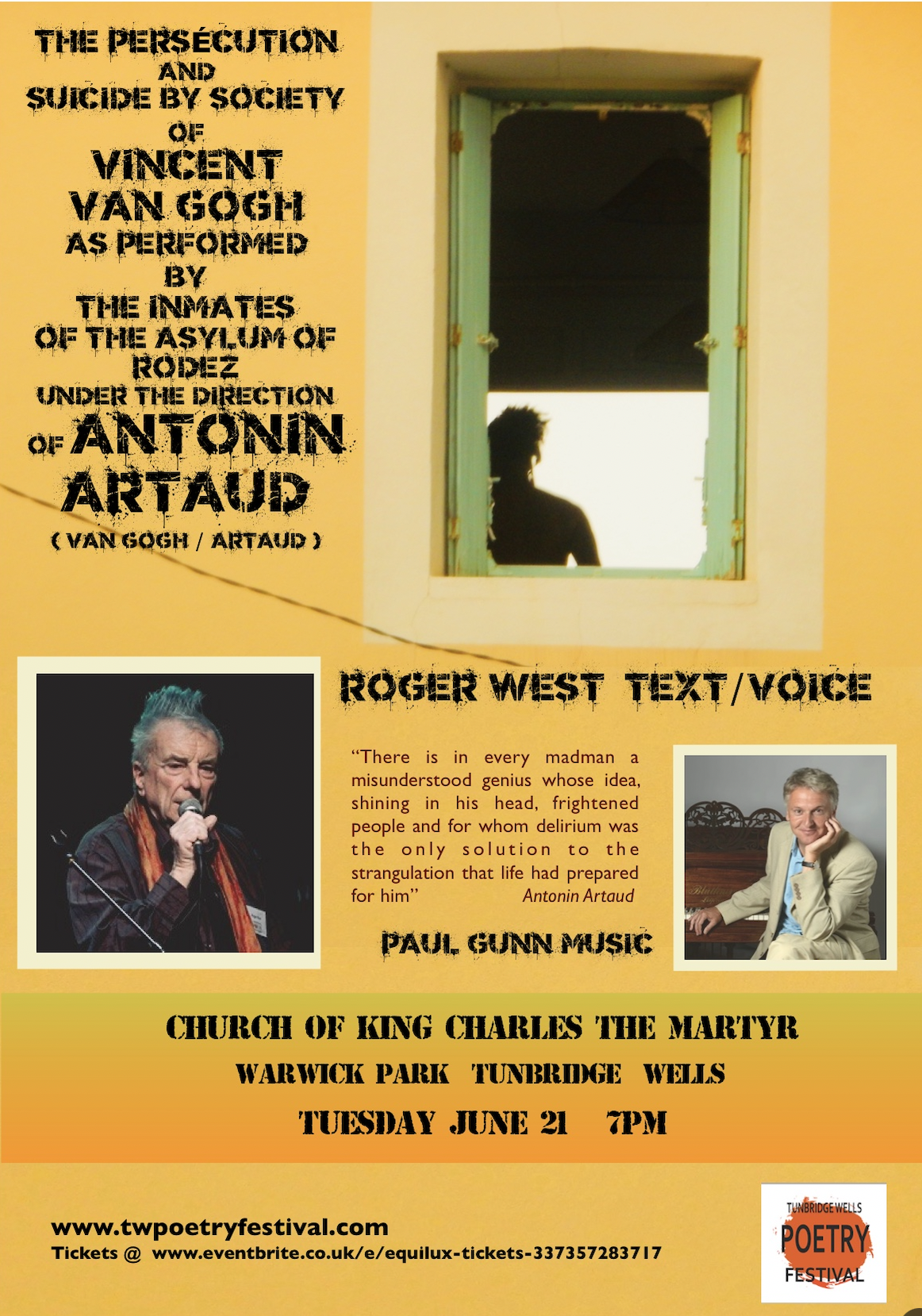
The persecution and suicide by society of Vincent Van Gogh as performed by the inmates of the asylum of Rodez under the direction of Antonin Artaud
A poetic performance with sound and music on the French surrealist poet and ‘homme du théâtre’, Antonin Artaud.
During World War II, Artaud was confined to the asylum in Rodez in the ‘liberated’ zone of France, where his psychiatrist subjected him to electric shock treatment in attempt to re-stimulate his poetry. Artaud’s subsequent writing dealt with the brutality of this experience and included several polemics on how psychiatrists seek to suppress and stamp out creative genius. Much of this crystallised in his essay on Van Gogh, whom he described as a “man suicided by society.”
This performance takes as its title and some of its inspiration Peter Weiss’ play ‘Marat/Sade’, produced by Peter Brook in a staging based on Artaud’s concept of a ‘theatre of cruelty’ with another link being Artaud’s own film performance as Marat. It draws upon some of Artaud’s writings but is an original text and a work of fiction.
In this performance, Artaud addresses the spectators as inmates of the asylum about his own staging of the death of Van Gogh, in which he intends to involve them, but his attempts at rehearsal are hampered by his own digressions on the nature of poetry and of bourgeois theatre, madness and creativity, collusion and collaboration with authoritarianism and his own struggles with his personal demons, concluding with a discourse/rant on the suppression of poetic expression moving between the past and the future.
The performance lasts around 50 minutes. It uses some pre-recorded music and sound but mainly uses music played live on stage. There is an English and a French version. It has been performed at Printemps des Poètes in Lodève, France, with Delphine Chomel on violin, at Festival Semaphore in Brittany with Gauthier Keyaerts on computer-generated sound, at the Tunbridge Wells Poetry Festival with Paul Gunn on piano and at Mots du Vent in Fontjoncouse, France, with Bob Morse on electric guitar and live painting.
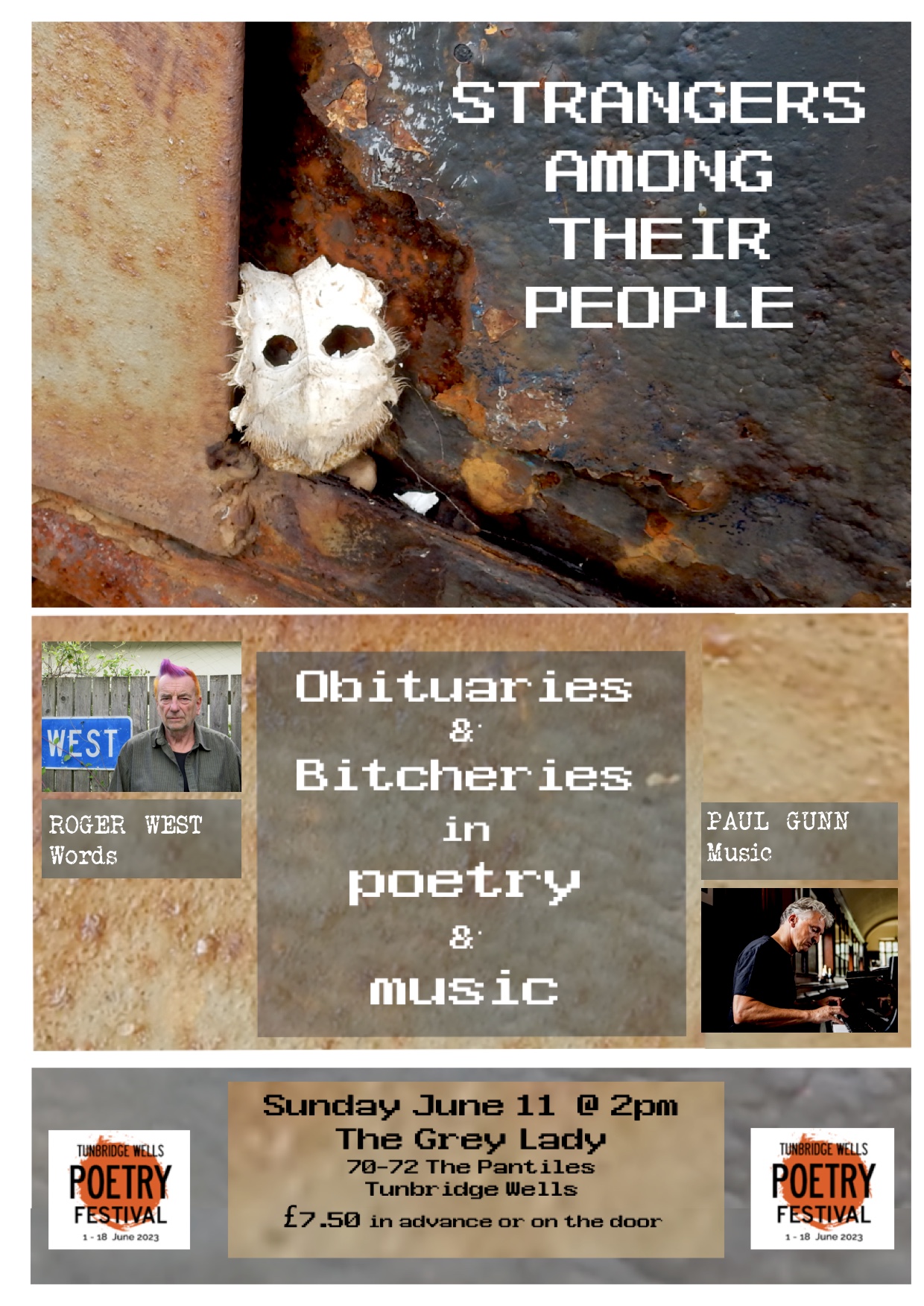
Strangers Among Their People
A changing and evolving collection of pieces in a variety of forms. Poetic responses to some of the most recent significant deaths – obituaries and bitcheries of the famous and infamous. The title is from Kahlil Gibran “Death resembles a poet who is a stranger among his people.” The performance lasts from 40 minutes to an hour or more; the content can be tailored to suit the event. It has been performed at the Tunbridge Wells Poetry Festival with Paul Gunn on piano.
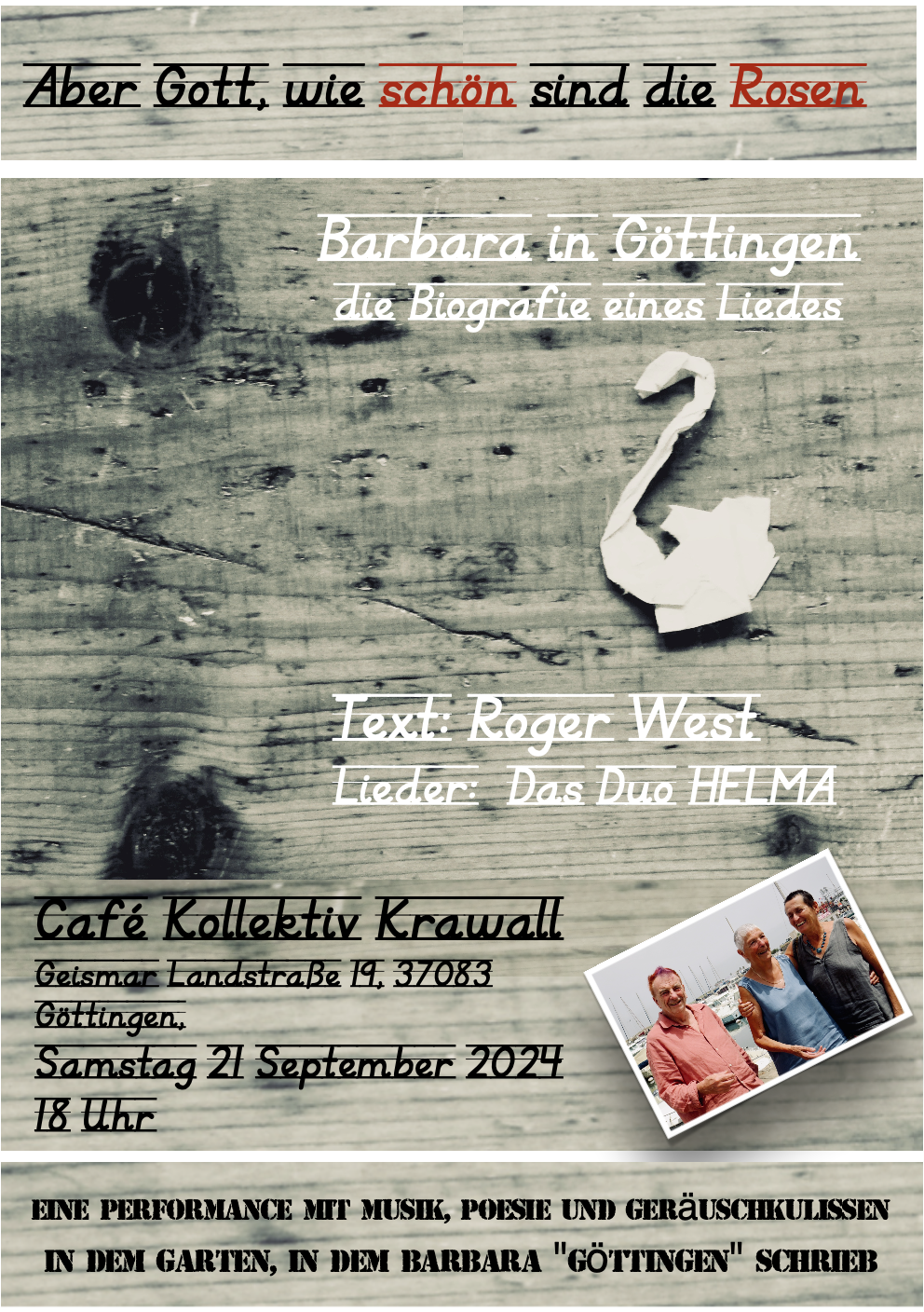
Mais Dieu Que Les Roses Sont Belles / But God the Roses are Beautiful.
A biography of the song ‘Göttingen’ by the French chanteuse, Barbara, now a hymn to post-war reconciliation in Europe and cultural inclusivity and a warning against the resurgence of the far right. She wrote the song after a concert in the German city of Göttingen and this piece is a poetic monologue in the voice of one of the spectators at the concert. The text is in French and was written to be performed accompanied by the duo Helma on voice, piano and accordion with the text interspersed with songs by Barbara and other French chanteuses/chanteurs from immigrant backgrounds. The performance lasts around 50 minutes, depending on the selection of songs. It was performed at Printemps des Poètes in Lodève, France, at the Maison Güth in Hoste, France and in a German version in Göttingen. in the garden of the Grimm Brothers, where Barbara wrote the song.
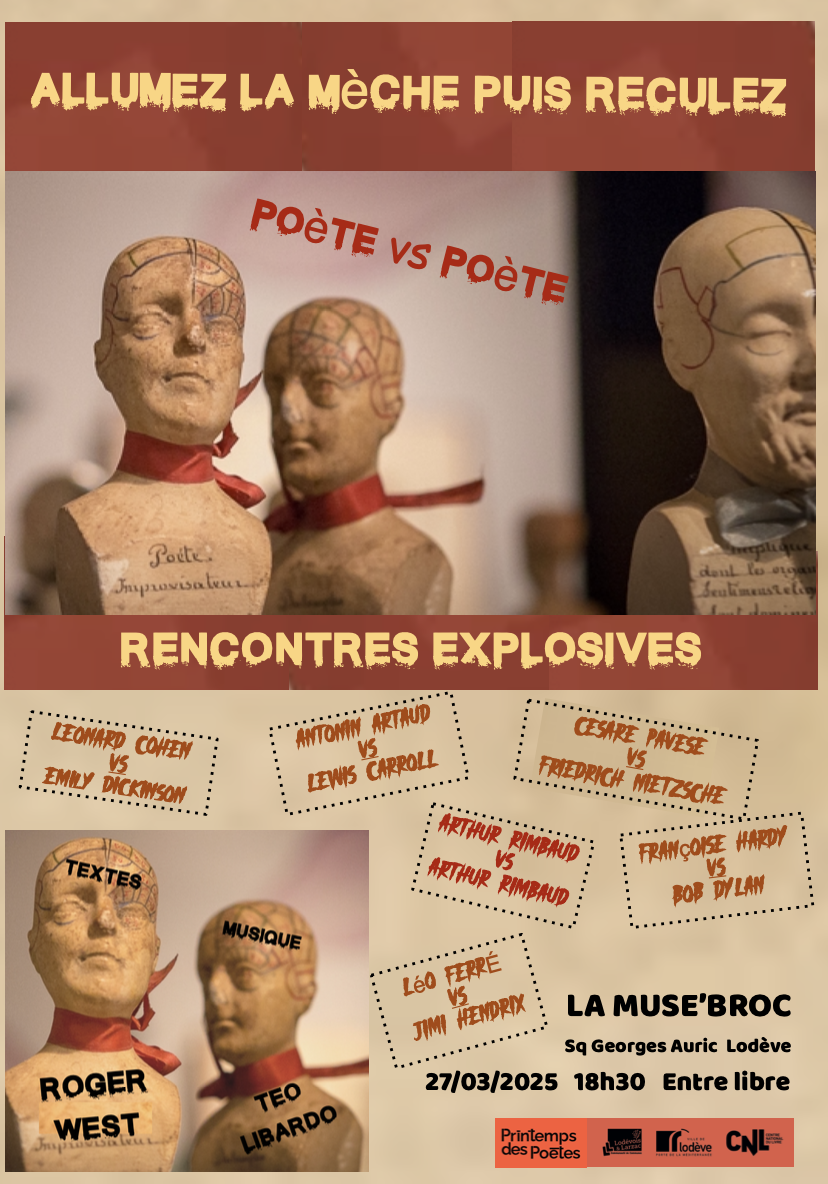
Allumez la Mèche et Reculez / Light the Blue Touch Paper and Stand Back.
A series of encounters between poets/musicians – probable, possible, actual, beyond imagination and just missed by a whisker. Jimi Hendrix meets Léo Ferré, Leonard Cohen meets Emily Dickinson, Antonin Artaud meets Lewis Carroll, Arthur Rimbaud meets his own worst enemies, Friedrich Nietzsche meets Cesar Pavese, Bob Dylan meets Françoise Hardy, Miles Davis meets Juliette Greco. The performance lasts 60 minutes. There is an English and a French version. It was performed at Printemps des Poètes in Lodève, France, with Teo Libardo on guitar and voice and a number of guest readers.
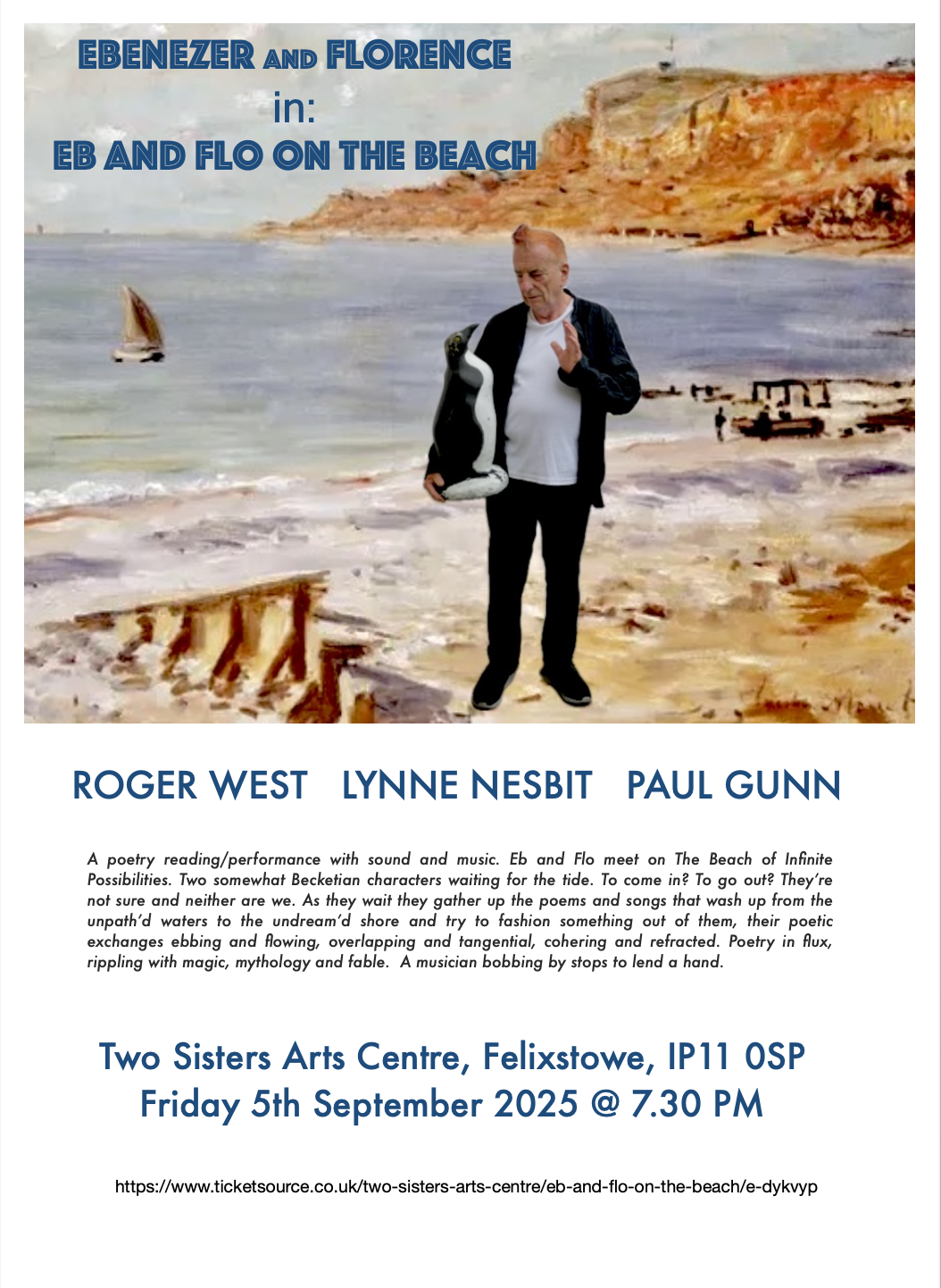
Ebenezer and Florence in: Eb and Flo on the Beach
Ebenezer and Florence – Eb and Flo – meet on The Beach of Infinite Possibilities. Two somewhat Becketian characters waiting for the tide. To come in? To go out? They’re not sure and neither are we. As they wait they exchange poems, songs and observations, their poetic conversation ebbing and flowing like the tide – sometimes overlapping, sometimes tangential; sometimes cohering, sometimes refracted. Poetry in flux, rippling with magic, mythology and fable. A musician bobs along. Electronic soundscapes wash up along the shoreline.
The performance lasts 55 minutes. It was first performed at the Two Sisters Arts Centre, Ipswich, with poet Lynne Nesbit.
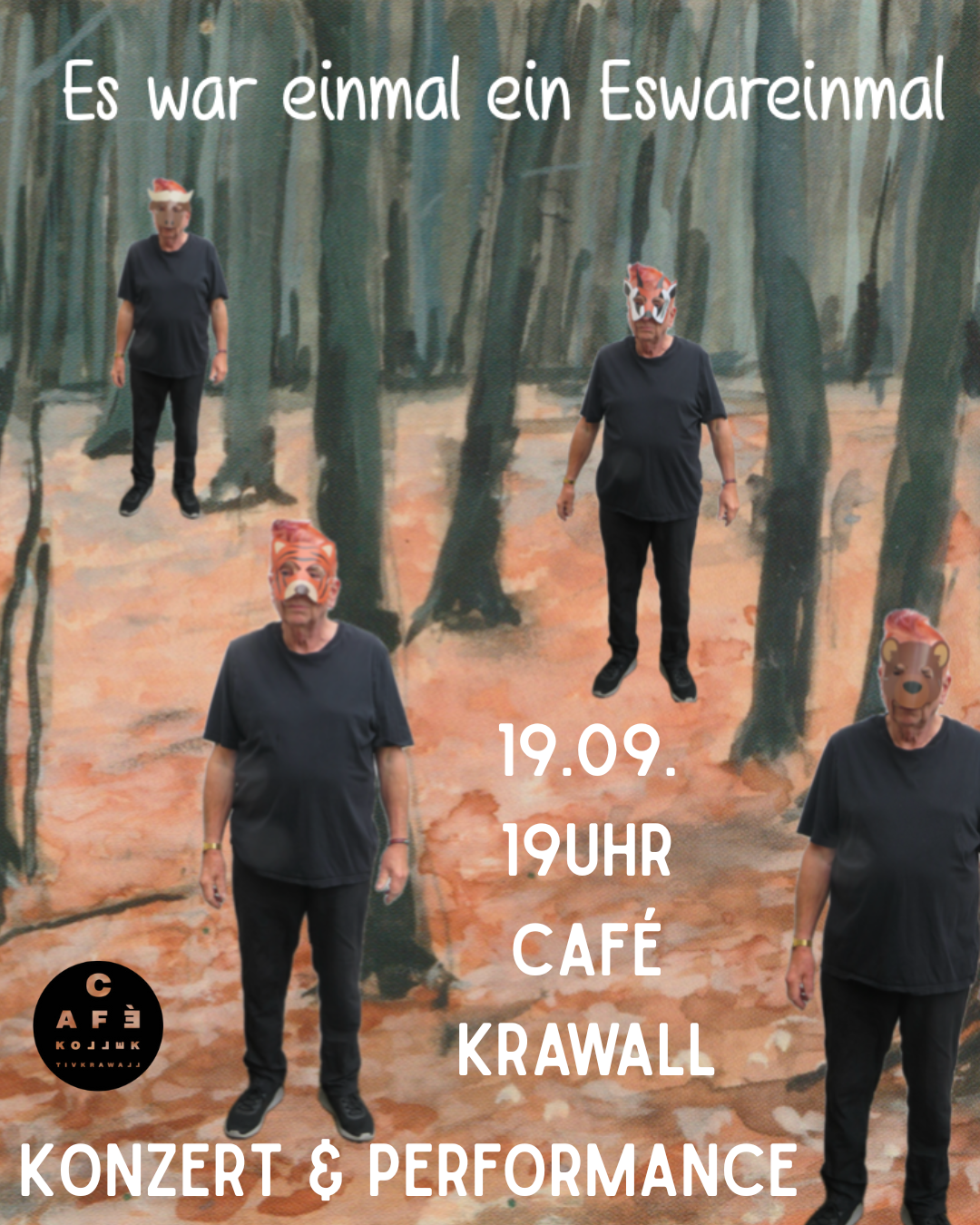
Once upon a time there was a once upon a time / Es war einmal ein Eswareinmal
A brotherless brother, a twinless twin, searching for a sibling. A riff on some of the themes from the tales of the Grimm Brothers, laced with possible and actual events from their own lives. The text deals with myth, magic and monsters, with gender identity and political resistance. A fairytale for all kinds of fairies. With live music and electronic soundscapes.
The performance lasts 50 minutes. It was first performed in a German version in the garden of Café Krawall in Göttingen, the garden which used to belong to the Grimms themselves.